
New London resident records answer different questions
A useful New London resident lookup starts by naming the question. The Vision property roll can connect a person to a parcel, but the owner field is not proof that the owner lives there. The Secretary of the State lookup can return registration status, party, and polling information, while protected addresses and full birth dates stay out of ordinary results. Court and probate indexes show a person’s role in a public proceeding. Vital records mark a birth, death, marriage, or adoption event. Licenses, entity filings, directories, and obituaries add context, not a single final answer.
| Record | What It Confirms | Where to Search | Access |
|---|---|---|---|
| Property roll | Owner name, situs, parcel key, sale and building clues | Vision New London | Free public search |
| Voter lookup | Registration status, party, polling place and district | Connecticut SOTS | Town, name and DOB match |
| Civil court | Party name, case category, docket and available status | Connecticut Civil Inquiry | Free, with public-record limits |
| Probate | Listed estate or trust case, name, type and district | Connecticut Probate Case Lookup | PD-31 and listed records |
| Vital record | Birth, death, marriage, civil-union, or adoption event | New London Clerk or DPH | Eligibility, ID and copy rules |
| Credential or entity | License status, business affiliation, or filing trail | eLicense and SOTS | Free public tools |
| Historical source | Earlier address, household, obituary, or family clue | PLNL, NLCHS, State Library | Appointment, request, or browse access |
Use the least broad record that can answer the question. An address clue points first to Vision or MapGeo. A registration question points to SOTS. An heir search points to probate, while a life-event question belongs with the City Clerk or Connecticut Department of Public Health. Keep a note of the exact spelling, record date, and source link so a later result can be compared rather than guessed.
Match a New London Resident Lookup
Names collide often in a small city. Try initials, middle names, suffixes, maiden names, married names, spelling changes, trustee names, and estate forms. A surname alone is a lead. A stronger match joins two independent fields, such as a name with a New London street, a known year, a spouse or parent, a parcel PID, an MBLU, or a case number. A New London resident lookup becomes credible only when that second field agrees.
Search the Vision Owner and Address modes, then record the parcel card’s owner spelling, situs, PID, MBLU, and visible sale rows. A separate mailing address was not visible on the inspected PID 987 sample, so the parcel address should never be copied into a missing mailing field. The same care applies to eLicense and business filings. A credential or entity address is an affiliation clue, not a residence claim. Keep the resident lookup tied to the field that actually matched.
Note: A same-name result becomes useful only after a second record agrees on a date, address, relationship, parcel key, or case detail.
New London court records need named filters
The Connecticut Judicial Branch gives New London a precise court-location filter. In Civil Inquiry Party Search, the last name is required and accepts up to 54 characters. The first name is optional and accepts up to 50. Choose KNL-New London JD when the New London Judicial District is the target, then narrow the category to CV or FA when appropriate. Case type codes include public categories such as zoning, taxation, FOI Commission, construction, contracts, municipal regulations, foreclosure, quiet title, and probate appeals. The portal also provides Starts With, Contains, Is Equal To, and Sounds Like matching, with Location or Name sorting.
| Search control | What the New London result needs |
|---|---|
| Party name | Last name required, first name optional; use variants with care. |
| Location | Choose KNL-New London JD or another listed judicial district. |
| Category and type | Use CV or FA, then choose the available official case code. |
| Name search | Starts With, Contains, Is Equal To, or Sounds Like. |
| Sort order | Location or Name. |
| Docket search | Location, category, two-digit year, seven-digit number, or full docket up to 19 characters. |
| Documents | Party information plus ALL, NONE, or LAST 10 motions, pleadings, and documents. |
A docket search is often the cleaner second step. Save the docket number, party role, filing or return information, status, disposition, and any public document link. Family, sealed, protected, juvenile, youthful-offender, infraction, and violation material can be absent. Older paper records may require the courthouse at 70 Huntington Street or a clerk request. Online information changes daily, so a clerk’s file remains the check when the result matters.
The docket search view was captured as a field schema rather than a stable New London case row. That distinction keeps a sample search from being mistaken for a verified person.
A public Civil Inquiry result can be inventoried without copying a sensitive document:
| Result field | What it can show |
|---|---|
| Docket number | The case identifier used for a clerk or file request. |
| Court location and category | Judicial district plus civil or family category when public. |
| Party names and roles | The person’s listed relationship to the case. |
| Filing or return information | Date and basic proceeding details when shown. |
| Status or disposition | The public case state or outcome field, subject to the portal’s limits. |
| Motions, pleadings, and documents | Only the public items allowed by filing date and access rules. |
The Judicial Branch docket search shows the filters used before a public case result is read.
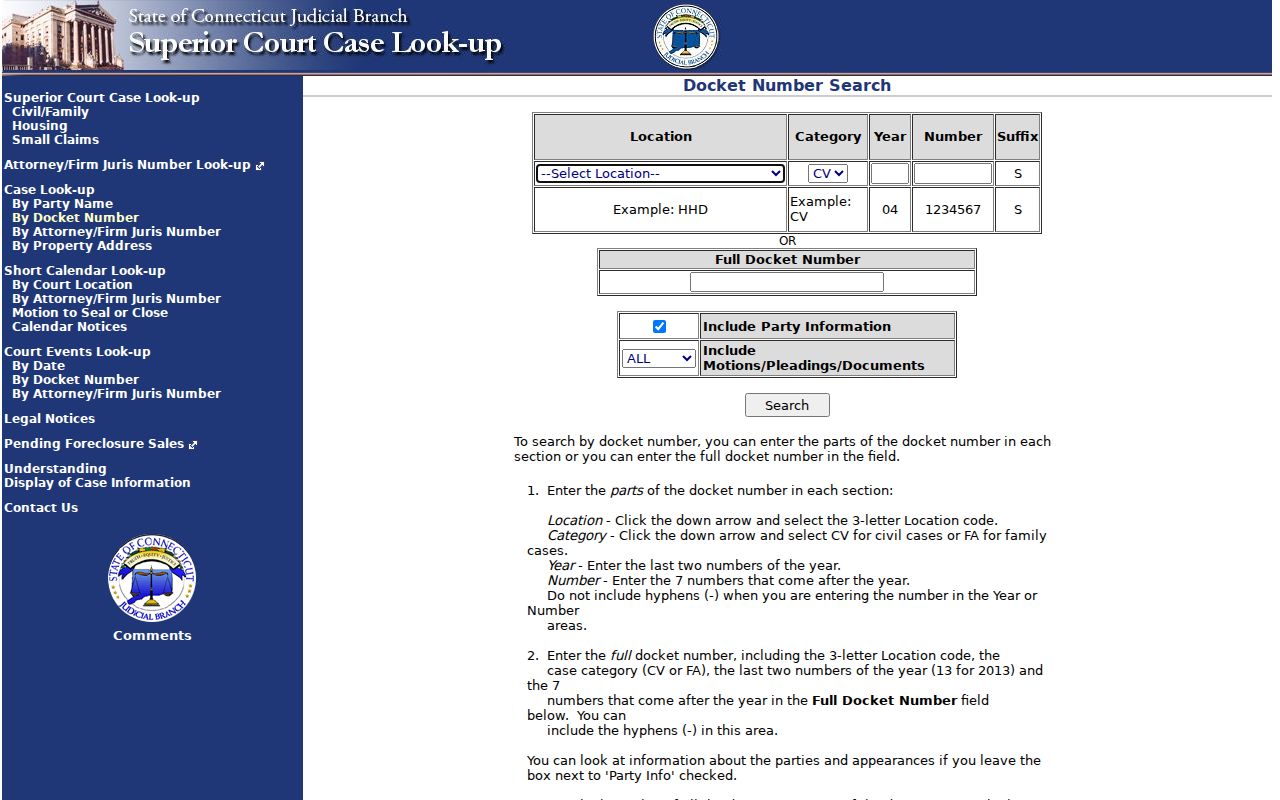
The docket screen is a starting index, not a promise that every filed paper can be opened. Use the number and clerk route for a fuller record.
Probate can identify an heir or fiduciary
New London Probate Court is PD-31 for New London and Waterford. Its public case lookup covers listed decedent estates and trusts from January 5, 2011 forward, with possible older or incomplete information. Search by case type, choose PD31-New London, select Both, Open, or Closed status, and add first or last name. The result columns are case number, last name, first name, middle initial, type, and district. A case number and fiduciary name give an heir search a firmer anchor than a name alone.
The court is at 181 State Street, Room 2, New London, with public hours Monday through Friday from 8 to 4 and phone 860-443-7121. Public lookup is free, but case documents are not automatically open. Interested parties and attorneys use the permitted eFiling route for pending matters, while self-represented parties request electronic access and verification. Older estate material belongs with the court or the Connecticut State Library.
The Connecticut Probate Case Lookup provides the district and status controls used for a New London estate or trust search.
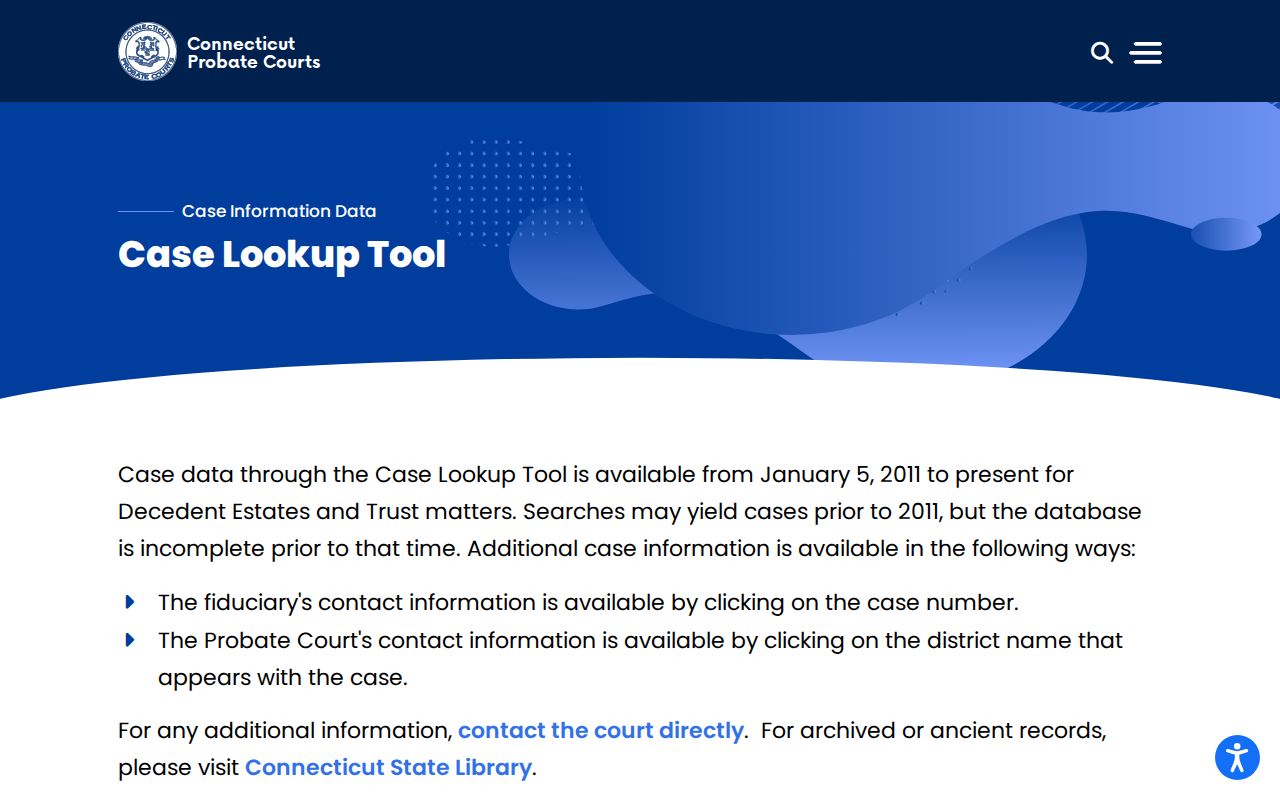
Probate confirms a public case relationship. It does not by itself prove that an heir lives at a parcel or that a listed fiduciary is the current occupant.
Confirm a New London life event
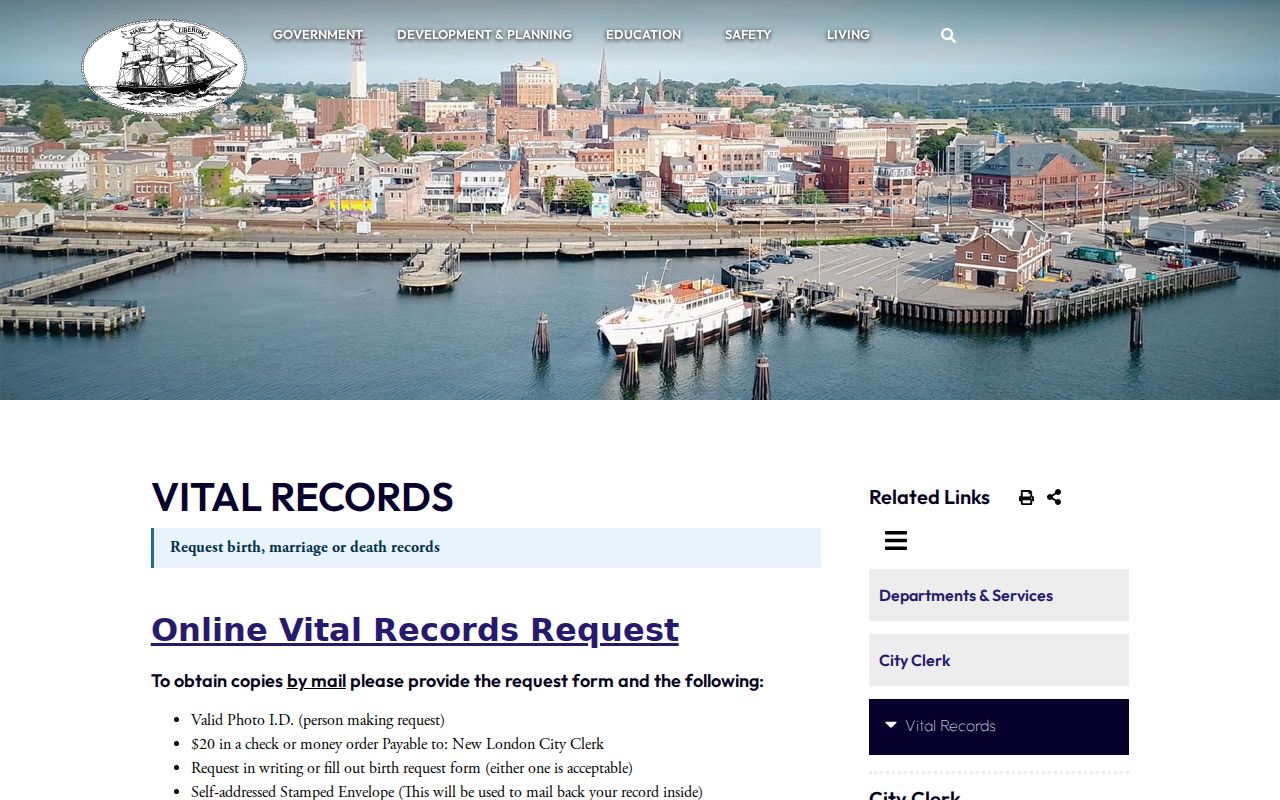
The New London City Clerk and Registrar of Vital Statistics at 181 State Street is the local first stop for a New London birth, death, or marriage record. The city provides an online request route, paper forms, phone help, in-person service, and mail instructions. Local forms state a $20 copy charge, ID requirements, and a self-addressed envelope. Accepted ID alternatives can include a Social Security card paired with an employee ID, a current utility bill, bank statement, voter card, government license, school photo ID, military discharge paper, or another listed document. Confirm the current payment method with the Clerk before mailing because local instructions and DPH instructions differ.
Connecticut DPH holds the statewide vital-record system from July 1, 1897 forward, while towns retain their own records. DPH processing can take up to 12 weeks. CGS §§7-51 and 7-51a restrict newer birth and fetal-death records, protect Social Security numbers, and set adult access rules for death and marriage copies. An adopted original birth record follows a separate route: the New London form states a $65 fee to the town of birth, adult eligibility rules, proof of relationship for an adult child or grandchild, and a court-order requirement for other requesters.
The New London vital records page brings the local request, ID, mail, and online channels together.
The DPH access guide is the statewide check for eligibility and timing when the local record is not enough.
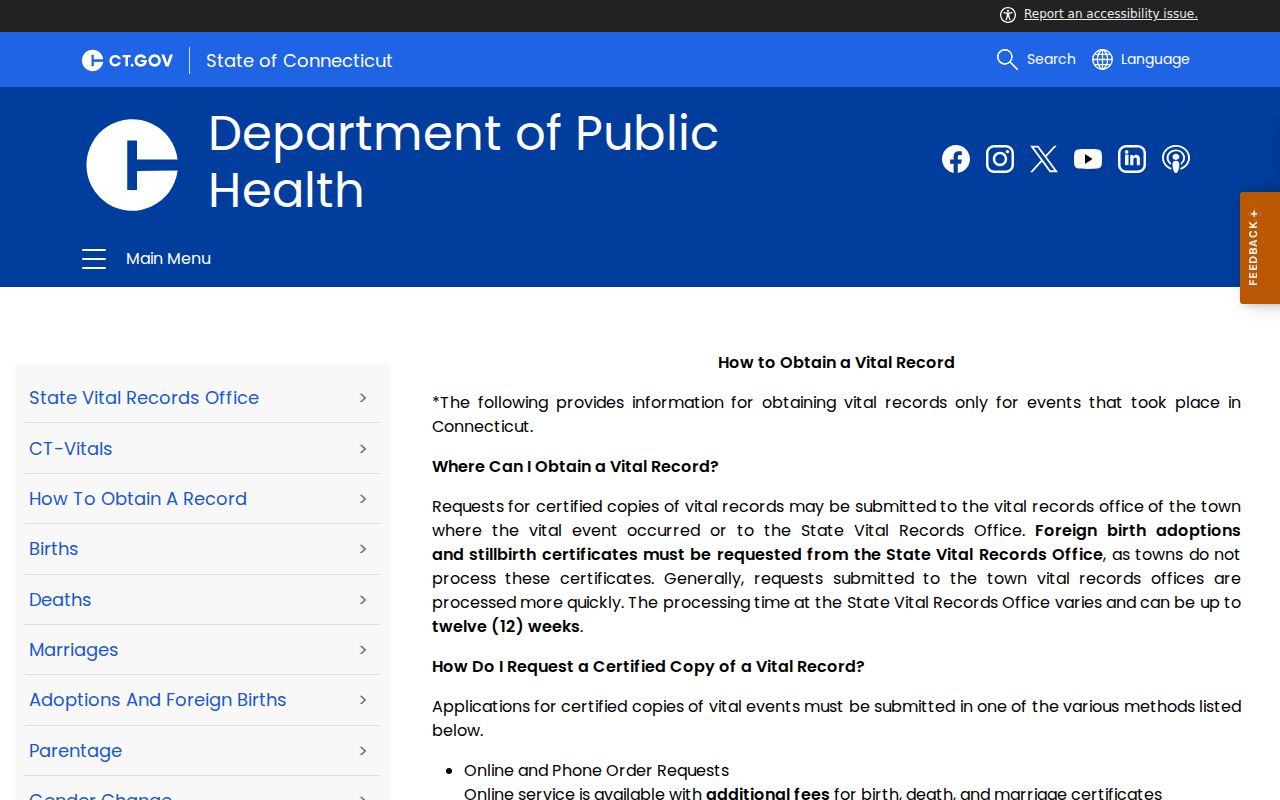
A vital result confirms an event and its legal copy path. It does not establish present residence at the event address.
Verify a New London resident
A careful resident lookup keeps the first result small and the second result independent. For a current name and address question, use this order:
- Run Vision by Owner or Address. Save the owner spelling, situs, PID or MBLU, sale rows, and access date.
- Use the Connecticut voter lookup with town, first name, last name, and date of birth. Keep only status, party, polling place, and district information allowed in the result.
- Search Civil Inquiry with KNL-New London JD and more than one name-match setting. Record the docket number, role, and disposition rather than treating a name hit as proof.
- Use Probate when the question concerns an estate, trust, heir, or fiduciary. Ask the court which documents may be viewed.
- Use a City Clerk or DPH vital request for a birth, death, marriage, or adoption event. Use PLNL, NLCHS, or the State Library for an older trail.
Three terms prevent common errors. A docket is the court’s numbered case record and its entries. An index is a finding aid that points to a record, while an image is the filed document itself. A certified copy is a custodian-issued copy with formal certification, not a browser printout.
- Docket
- A numbered court case with parties, filings, status, and related entries.
- Index versus image
- An index helps locate a record. The image or file carries the document text and may have separate access rules.
- Certified copy
- A formal copy issued by the record custodian for an eligible request.
- Situs
- The physical parcel location, which may differ from a notice or mailing address.
Older New London residents leave paper trails
For a former classmate, birth parent, relative, or family-history question, the Public Library of New London can close a modern index gap. Its local-history service holds city directories, The Day microfilm from July 1881 to the present, newspapers, photographs, and research-request channels. The New London County Historical Society adds a marriage and death newspaper index for 1758 to 1866, early census material, wills, property and tax papers, maps listing property owners, school annuals, family Bible records, and private papers. Ask for a focused year, street, or event rather than a broad name request.
The State Library and FamilySearch add catalog and microfilm routes. Compare adjacent directory years, then pair the address with an obituary, census, deed, probate entry, or vital index. The directory citation used in the William and Celinda Harris Anderson Black Heritage Trail research points to a New London City Directory entry from 1853 to 1854, but the exact page text still needs a careful image transcription. Treat the citation as a lead, not as a complete household record. An older resident lookup should preserve that uncertainty.
When New London resident lookups stop online
Some trails are narrow by design. eLicense can show license type, status, number, name, business, address, city, state, ZIP, country, and a detail route, but a credential address is not a residence proof. The Secretary of the State business search is dynamic and its exact field and image behavior can change. CTBIGLIST.gov offers a free name search, but a claimant must provide proof before unclaimed property is released. DESPP criminal-history products are separate from a court docket: a name and date-of-birth existence search is $36, a conviction-history copy is $75, and a fingerprint-based state history adds $15 for fingerprinting. DOC and registry tools serve narrow official purposes. For one resident, use the lookup rather than the restricted $300 full voter-file CSV request, whose certification limits use to permitted election-related, scholarly, journalistic, political, or governmental purposes.
When an index fails, use the office that made the record. The City Clerk, assessor, registrars, Probate Court, Judicial Branch clerk, DPH, PLNL, NLCHS, and State Library each answer different questions. Phone first when an office has a current payment, appointment, or eligibility rule. Mail the prescribed vital or DESPP form. To look up a resident responsibly, keep the request narrow. A Connecticut FOI request under CGS §§1-200 through 1-259 can seek eligible municipal administrative records, but it cannot bypass protected vital, voter, adoption, court, or safety material.
Note: Keep the source URL, access date, exact spelling, and record identifier with every search so a correction request can reach the right custodian.
Legal limits around New London resident records
Connecticut’s public records system is open in layers. The Address Confidentiality Program, also called Safe at Home, can replace an eligible participant’s actual address with a substitute mailing address. The separate Voter Registry Privacy Program can suppress a protected voter’s actual address from ordinary release without proving that the person left New London. Birth records under 100 years, adoption originals, sealed or protected court files, juvenile material, and restricted Social Security numbers have their own rules. A blank or limited result may reflect a lawful protection.
PA 22-15, the Connecticut Data Privacy Act, took effect July 1, 2023 and gives covered businesses rights involving access, correction, deletion, portability, third-party disclosure, and opt-out signals. It generally does not erase government or publicly available records. If a record is wrong, contact the custodian with the record identifier and documentary correction request. If a caller uses a public name or address to demand money, verify through an independently known office number. New London’s June 17, 2026 scam alert described three reports of callers impersonating a police officer or family member, demanding cash at a public place through TextNow; the city directed reports to New London Police at 860-447-5269, extension 0. Connecticut stalking and harassment statutes, including CGS §§53a-181c, 53a-181d, 53a-181e, and 53a-183, put clear limits on repeated contact and threats.
Lawful use. A New London resident lookup is for personal, lawful research, family history, reconnection, and record verification. Do not use public information to stalk, harass, intimidate, or publish a protected address.