
New London Previous Residents Era Map
A backward address search needs an era map before it needs a name. New London records sit with the City Clerk, local libraries, the historical society, state archives, federal census collections, and map repositories because Connecticut has no current county recording office. The online land-record cutoff for New London CountyFusion was not exposed during research, so the City Clerk vault remains part of the plan. The table separates ownership records from occupant evidence and from physical-building clues.
| Source | Years it covers | Where held | What it can show |
|---|---|---|---|
| City Clerk land records and CountyFusion | Online cutoff not exposed; older vault history continues earlier | New London City Clerk, CountyFusion, in-person vault | Deeds, mortgages, liens, releases, parties, legal descriptions, book and page |
| New London city directories | 1853 onward; documented runs through at least 1965 | PLNL, NLCHS, FamilySearch catalog and microfilm leads | Occupants, addresses, occupations, spouses, household marks |
| The Day microfilm | July 1881 to present | Public Library of New London | Obituaries, realty notices, community news, legal notices |
| NLCHS marriage/death index and newspapers | Index 1758-1866; regular newspaper series to 1904, scattered later | New London County Historical Society | Life events, notices, property and local context |
| Federal census | Public schedules through 1950 under the 72-year rule | NARA, FamilySearch, and library databases | Household members, age, occupation, birthplace, address geography |
| Sanborn fire-insurance maps | 1884, 1891, 1896, 1901, 1907, 1912, 1921; 1954 republication record | Library of Congress and PLNL reference | Building footprint, use, additions, and block change |
| New London Landmarks address files | Collection-specific | Appointment at New London Landmarks | Building histories, photographs, clippings, maps, drawings |
Start with the source that matches the question. A deed can identify an owner or legal party without proving residence. A directory can place an occupant at a street without proving ownership. A Sanborn sheet can confirm that a structure existed without naming the household. Previous residents become clearer when two or more of those signals agree.
New London Parcel Card Starting Point
The New London Assessor's Vision Government Solutions search gives an address trail a stable first key. Its search-source choices are Address, Owner, Acct#, MBLU, PID, and All. An address is useful when the house is known. An owner search helps when a deed or obituary supplies a name. MBLU and PID are better for carrying the same parcel through a spelling change, a unit label, or a street-number question.
| Search source | Address, Owner, Acct#, MBLU, PID, or All. |
|---|---|
| MBLU parts | Map, Map Cut, Block, Block Cut, Lot, Unit, and Unit Cut fields appear when MBLU is chosen. |
| Parcel card | Owner, situs address, PID or MBLU, values, sale rows, building facts, sketch, and photo links may appear. |
| Carry-forward keys | Preserve book and page, sale date, instrument, PID, MBLU, street spelling, and any legal-description clue. |
The inspected PID 987 card is a useful format example. It shows a New London situs address, PID 987, an MBLU, owner fields, appraisal and assessment values, a 1965 building year, and several sale-history book and page rows. Those rows point toward recorded documents. They do not prove that the named owner lived at the property, and the sample did not expose a separate mailing address. Keep situs, mailing, owner, and occupant as separate fields in every previous residents note.
Open the New London Vision property search to establish the parcel key, then preserve the result date and the loaded assessment year before moving to older sources.
New London Deed Chain, with an Online Gap
The backward owner trail runs from a current parcel card to a recorded purchase, then from the seller to the seller's earlier purchase. New London's City Clerk is the practical local recorder because Connecticut has no separate county recorder. The City's land-record page links to CountyFusion, but the New London portal returned an HTTP 502 during research. Its online start year, image behavior, document filters, and exact copy charges remain unknown. That gap should be named, not filled with a guessed cutoff.
- Copy the current owner, PID or MBLU, situs address, legal-description clue, and every visible sale-history book and page row.
- Use the CountyFusion book and page or grantor and grantee search when the local index is available.
- Read the purchase deed and keep its legal description, instrument date, parties, trustee or estate names, and lot or unit language.
- Search the seller as the prior grantee, then test the same legal description against the next earlier deed.
- Repeat backward while checking spelling, trustee names, estate names, and changes in street wording.
- Bridge each owner to a directory, census, obituary, probate file, or Landmarks address file before calling the person a prior occupant.
Kofile's search-help page describes generic Grantor, Grantee, Document Type, Recorded Date, Document, Legal Description, and Book or Volume or Page fields. It also describes AND or OR searches and advanced name, date, party-type, and image-text modes. Those mechanics explain how a deed search may work, but they do not establish New London coverage or the local portal's current status.
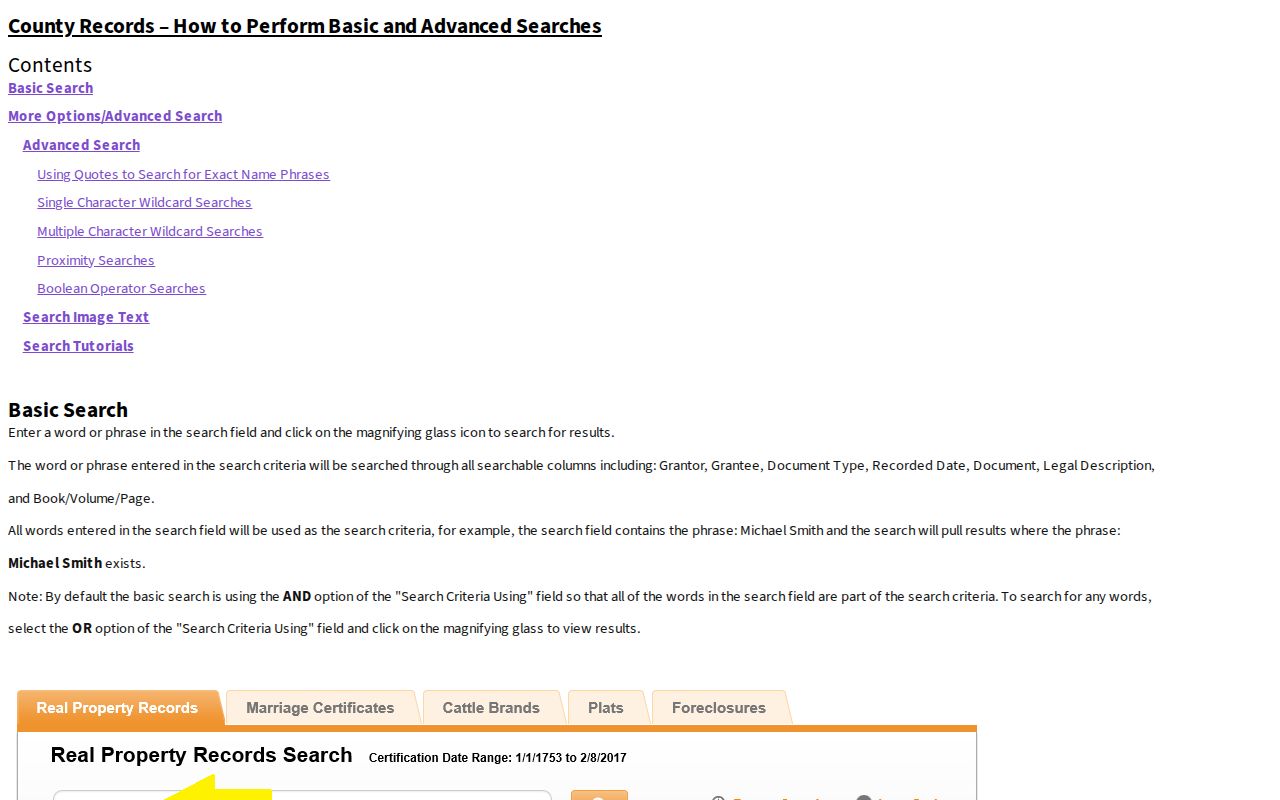
The search-help image is useful as a field guide. For a New London request, confirm the local index with the City Clerk and use the in-person vault or title-search appointment when the web route is unavailable.
The City Clerk's land-record page gives the practical fallback: recordings must arrive by 3:45 p.m., and title searches are available by appointment. The office is at 181 State Street. Ask which years are online, which are book-only, whether older grantor and grantee indexes are on microfilm, and how to request a certified copy.
New London City Directory Backward Trail
Deeds name legal parties. City directories add the household layer. New London's local directory trail begins with the 1853-54 Turner volume and includes later New London, county, and regional titles from publishers such as Williams & Bacon, New London Publishing Co., Christopher Prince, Day Publishing Co., and Price & Lee. Documented runs include the 1902 Day volume, Price & Lee listings from 1903-06, and regional volumes through at least 1965. There is no safe claim of an uninterrupted sequence or a final printed year.
Use a directory to test whether a deed party appears at the same street, whether a spouse or household mark changes, and whether a business address is being mistaken for a home. Ask for reverse, criss-cross, address-to-name, and telephone material by year, but do not assume that a separate reverse series exists. The historical collections and reading method are kept on the New London directory book page, while this backward trail uses those volumes as one link among several.
New London Landmarks Address Files
When a street number has changed or a building needs a physical history, New London Landmarks can bridge the printed name record and the place. Its research files are organized by street address. The collection may include building histories, historic and current photographs, newspaper clippings, maps, architectural drawings, and related documents. That address-first arrangement makes it especially useful for previous residents because the file can hold continuity clues even when a directory year is missing.
Appointments are available at 49 Washington Street, with 860-442-0003 as the listed phone. Bring the current parcel key, every old street spelling, the earliest known house number, and any deed book and page. Ask the archivist to distinguish a building change from a person change. A new addition, demolition, subdivision, or number change can make a name search look like a disappearance when the structure itself has shifted.
New London Landmarks research archives provide the address-file route for that kind of question.
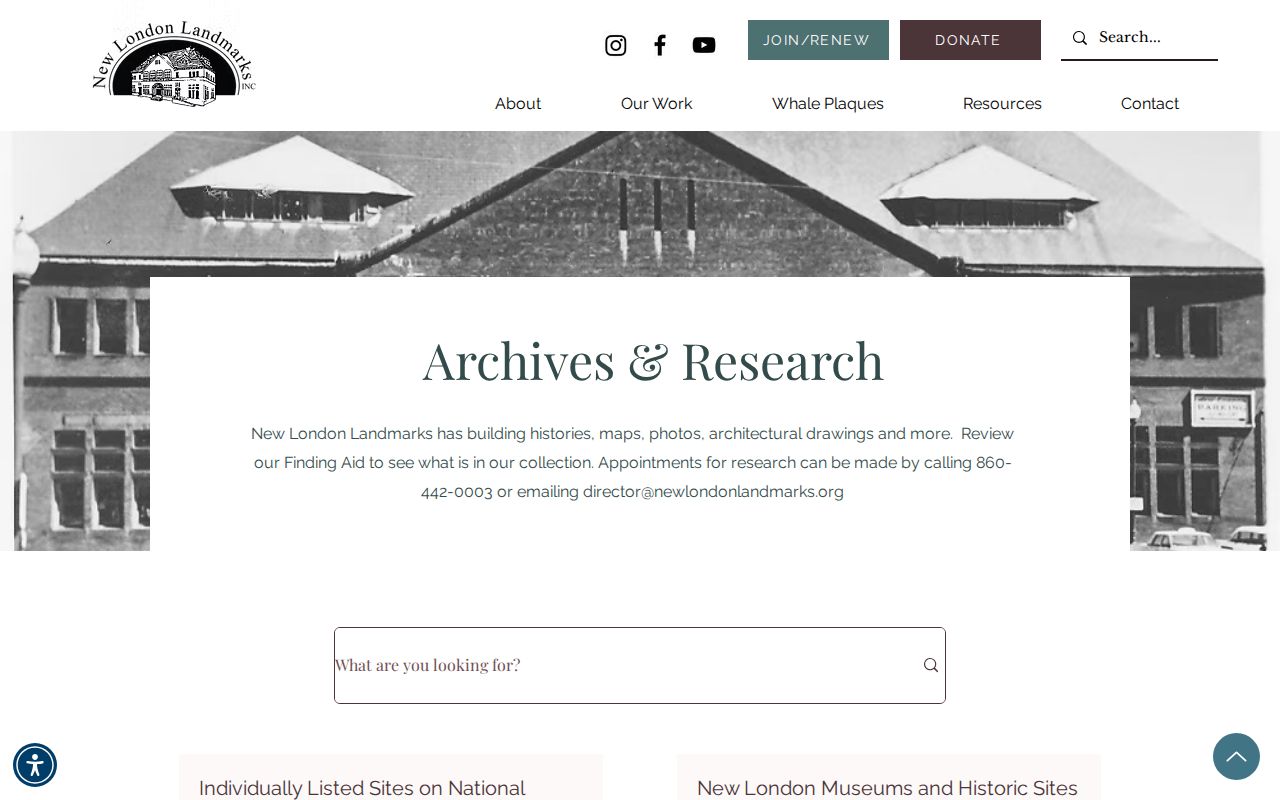
The Landmarks image belongs beside the address trail because photos, clippings, drawings, and maps can test whether the old entry belongs to the same physical structure.
New London Sanborn Maps and Structure Dates
Sanborn fire-insurance maps help answer a narrow question: what stood on the block when a directory or deed names an address? New London coverage is documented for 1884, 1891, 1896, 1901, 1907, 1912, and 1921, with a 1954 republication record. The sheets can show footprints, building use, additions, and the relationship of a structure to its neighbors. They do not create a list of everyone who lived inside.
The Library of Congress New London 1891 item is a text source and scan lead. Its accessible capture did not expose a usable image, so no exact map label or sheet transcription is claimed. Use the documented year sequence to choose a map, then compare its footprint with a Landmarks file, a directory street entry, and the legal description in the deed.
Map limit. A Sanborn footprint can confirm a building and its use at a point in time. It cannot confirm the identity of a prior occupant without a separate name source.
New London Day and NLCHS Newspaper Trail
The Public Library of New London has the complete The Day microfilm run from July 1881 to the present. A directory entry can narrow the search to a likely year, street, spouse, occupation, or move. A newspaper may then supply an obituary, realty notice, community item, legal notice, or death-related clue. The library asks for a specific question and a known date when possible, and broad unknown-date work may need an appointment.
For earlier material, New London County Historical Society has a marriage and death index for 1758-1866. Its newspaper holdings begin with a 1758 photostat, run regularly through 1904, and include scattered later issues. The society's appointment route is at 11 Blinman Street, research@nlchs.org, and 860-443-1209. A preliminary email search is $10, additional staff research is $40 per hour, and in-person research is free by appointment. These channels can close a date gap without turning an obituary into proof of the exact address on every day of a person's life.
PLNL local-history research requests and the NLCHS archive research service are different access routes. Use the library for its complete Day run and the society for its earlier index and broader manuscript context.
New London Previous Residents with Census Pairing
The federal census supplies household snapshots rather than an annual trail. Pair a directory year with the 1900, 1910, or 1920 census when the address and family fall within the schedule. The latest fully public census is 1950 under the 72-year rule. A census page can add age, birthplace, household members, and occupation, but its address geography may use an enumeration district rather than the modern street label.
- Write down the directory name, street, household notation, and nearby entry before opening a census image.
- Search the census with surname, given name, spouse or child, and the closest known street or district.
- Compare age, birthplace, occupation, and household order rather than relying on a name alone.
- Test the result against the deed chain, an obituary, a vital index, or a Landmarks file.
- Mark the conclusion as owner, occupant, boarder, business contact, or unresolved when the records do not agree.
The FamilySearch New London catalog supplies births, marriages, and deaths from 1644-1922 on seven reels, with indexes for most volumes. Some images need an account. Those event records can anchor a life stage, but a birth, marriage, or death record is not by itself proof that someone lived at a particular New London address on a particular date.
Household Clues for New London Previous Residents
The strongest previous residents timeline separates four kinds of relationship. A deed party may own, sell, mortgage, or release an interest. A directory entry may list an occupant, spouse, boarder, or business. A census may place several people in one household on its enumeration date. A map or address file may show the building, not the names inside. Put each result in its own column so an attractive name match does not become an unsupported claim.
- Grantor and grantee
- The grantor transfers an interest; the grantee receives it. In a deed chain, search the seller as an earlier grantee when working backward.
- Chain of title
- The linked record history of an interest in land, carried from one recorded transfer to the next.
- Legal description
- The deed's formal land identifier. It can remain useful when a street name, number, or postal label changes.
- Criss-cross directory
- An address-to-name arrangement that may reveal an occupant when a name-first directory does not.
- Enumeration district
- The census area used by the enumerator. It may not match a modern neighborhood or street boundary.
Watch for “bds,” “boards,” widow, estate, spouse, trustee, and business marks. Each is a research prompt. Compare adjacent directory years, then use a deed, newspaper, probate paper, or map to decide whether the change is a move, death, transfer, or simple collection gap.
New London Previous Residents and Source Gaps
A careful New London previous residents result can end with an unresolved interval. CountyFusion's New London cutoff and image behavior are not exposed in the research record. The city-directory holdings do not establish an uninterrupted series or a last printed year. The reverse-directory question is still open, so a street-page scan may be needed. The exact 1853-54 page 18 entry cited in Black Heritage Trail research also needs a captured image and transcription before any line is quoted.
Use the fallback chain instead of filling the gap with a guess. Ask the City Clerk about the vault and title-search appointment. Ask PLNL whether an unknown-date request needs a visit. Ask NLCHS for a narrow email search or a free in-person appointment. Ask Landmarks to test the old number against its address file. Then label the result as documented owner, likely occupant, possible household member, or open lead.
Lawful use. New London previous residents research is appropriate for family history, house history, genealogy, and personal curiosity. Do not use an address trail to stalk, harass, intimidate, or track a living person.